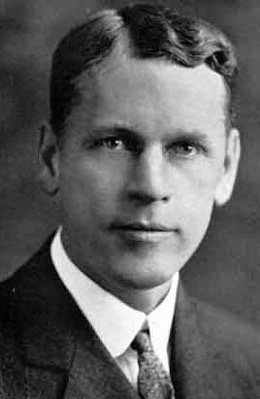
Involved in overseeing the World War II work that produced the pioneering ENIAC electronic digital computer, Veblen was also an American mathematician, geometer, and topologist whose work found application in atomic physics and the theory of relativity. He proved the Jordan curve theorem in 1905. During his career, Veblen made important contributions in topology and in projective and differential geometries, including results important in modern physics. He also published a paper in 1912 on the four-color conjecture.
He introduced the Veblen axioms for projective geometry and proved the Veblen–Young theorem. Veblen introduced the Veblen functions of ordinals and used an extension of them to define the small and large Veblen ordinals. He was also involved in overseeing the World War II work that produced the pioneering ENIAC electronic digital computer.
He was born in Decorah, Iowa and went to school in Iowa City. He did his undergraduate studies at the University of Iowa, where he received an A.B. in 1898, and Harvard University, where he was awarded a second B.A. in 1900. For his graduate studies, Veblen went to study mathematics at the University of Chicago, where he obtained a Ph.D. in 1903. His dissertation, A System of Axioms for Geometry, was written under the supervision of E. H. Moore.
He taught mathematics at Princeton University from 1905 to 1932. In 1926, he was named Henry B. Fine Professor of Mathematics. In 1932, Veblen helped organize the Institute for Advanced Study in Princeton, resigning his professorship to become the First Professor at the Institute that same year. He held his Professorship at the Institute until he was made Emeritus in 1950.
After his death in 1960, the American Mathematical Society created an award in his name, called the Oswald Veblen Prize in Geometry. It is awarded every three years, and is the most prestigious award in recognition of outstanding research in geometry. Publications he co-authored include: "Projective Geometry" with John Wesley Young (Ginn and Co., 1910–1918); and "Introduction to Infinitesimal Analysis; Functions of One Real Variable" with N. J. Lennes (John Wiley & Sons, 1907).