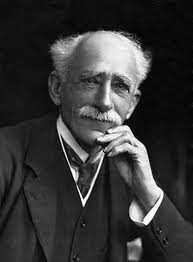
Inventor of the first thermionic valve or vacuum tube, Fleming transformed the foundations of modern electronics. After leaving the University of Nottingham in 1882, Fleming took up the post of "Electrician" to the Edison Electrical Light Company, advising on lighting systems and the new Ferranti alternating current systems. In 1884 Fleming joined University College London, taking up the Chair of Electrical Technology, the first of its kind in England. Although this offered great opportunities, he recalled in his autobiography that the only equipment provided to him was a blackboard and piece of chalk.
In 1897 the Pender Laboratory was founded at University College, London, and Fleming took up the Pender Chair after the £5000 was endowed as a memorial to John Pender, the founder of Cable and Wireless. In 1899 Fleming became Scientific Advisor to the Marconi Company and soon after began work on designing the power plant to enable the Marconi Company to transmit across the Atlantic.
In November 1904, he invented the two-electrode vacuum-tube rectifier, which he called the oscillation valve. Fleming later patented this invention. It was also called a thermionic valve, vacuum diode, kenotron, thermionic tube, or Fleming valve. The Supreme Court of the United States later invalidated the patent because of an improper disclaimer and, additionally, maintained that the technology in the patent was known art when filed.
This invention is often considered to have been the beginning of electronics, for this was the first vacuum tube. Fleming's diode was used in radio receivers and radars for many decades afterwards, until it was superseded by solid state electronic technology more than 50 years later.