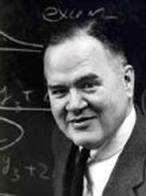
Known for his contributions to the spectral analysis of random processes and the fast Fourier transform (FFT) algorithm, Tukey left a profound mark on modern statistics and signal processing.
During World War II, Tukey worked at the Fire Control Research Office and collaborated with Samuel Wilks and William Cochran. After the war, he returned to Princeton, dividing his time between the university and AT&T Bell Laboratories.
Among many contributions to civil society, Tukey served on a committee of the American Statistical Association that produced a report challenging the conclusions of the Kinsey Report, Statistical Problems of the Kinsey Report on Sexual Behavior in the Human Male. His statistical interests were many and varied. Tukey is particularly remembered for his development with James Cooley of the Cooley–Tukey FFT algorithm. In 1970, he contributed significantly to what is today known as the jackknife estimation—also termed Quenouille-Tukey jackknife. He introduced the box plot in his 1977 book, "Exploratory Data Analysis".