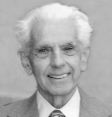
Pioneer in the development and research of computers and computer technology in the GE DATANET, Bridge began his engineering career during the seminal years of digital computer technology. He joined the SEAC computer project at the National Bureau of Standards in 1950, immediately after receiving his Bachelor of Electrical Engineering degree, Cum Laude, from the Catholic University of America, in Washington, DC. The following four years at NBS provided an education in computer science unrivalled at that time.
This was the era of vacuum tube computers. Delivery of the first commercial computer, UNIVAC I, with its 5,400 vacuum tubes, was a year away. NBS developed SEAC to train engineers and programmers for government agencies that ordered the first few UNIVAC systems. During its first year of operation, SEAC was the world's fastest, fully operational computer.
During 14 years of operation, SEAC served far beyond its role as a training device. The Atomic Energy Commission commandeered it for designing the hydrogen bomb. The National Security Agency applied SEAC technology on larger, faster computers. Some of the earliest software assemblers and compilers were developed on SEAC. Experiments were conducted on SEAC in remote computing, advanced peripheral devices, and air traffic control tracking with radar.