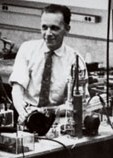
Developer of the modern solar cell and other important transistor breakthroughs, Ohl was a notable semiconductor researcher prior to the invention of the transistor. He patented the modern solar cell (US Patent 2402662, "Light sensitive device"). He entered Pennsylvania State University at the age of 16, and in his senior year he took a course in vacuum tubes — used at the time for radio. His specialized area of research was into the behavior of certain types of crystals.
He worked on materials research in the 1930s at AT&T's Bell Labs' Holmdel facility, investigating diode detectors suitable for high-frequency wireless, broadcasting, and military radar. His work was only understood by a handful of scientists in the organization, one of whom was Dr. Walter Brattain (one of the trio who invented the germanium bipolar transistor in 1947, and who would be awarded the Nobel Prize for Physics in 1956).
In 1939, Ohl discovered the PN barrier (or as it became known, the "P-N junction"). At the time hardly anyone knew anything about the impurities within these crystals, but he discovered the mechanism by which it worked. It was the impurities which made some sections more resistant to electrical flow than others, and thus it was the "barrier" between these areas of different purity that made the crystal work.
He later found that super-purifying germanium was the key to making repeatable and usable semiconductor material for diodes. All diodes (incl. LEDs, laser diodes etc.) are descendants of his work. This work with diodes led Ohl to develop the first silicon solar cells.