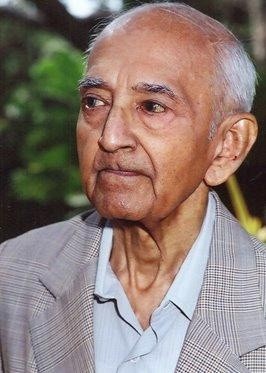
Often referred to as the Bhisma of Computer Science and Technology in India, Narasimhan made significant contributions to the development of computer science education, research, and technology in India in the early stages. After obtaining a degree in Telecommunication Engineering from Madras University in 1947, he went to the U.S.A. for post-graduate work, receiving an M.S. in Electrical Engineering from California Institute of Technology, and subsequently a Ph.D. in Mathematics from Indiana University.
He joined the Tata Institute of Fundamental Research (TIFR), Bombay, in 1954, and spent thirty-six years there, retiring in 1990 as a Professor of Eminence. During the period 1954–1960, he led a team that designed and built the Tata Institute of Fundamental Research Automatic Calculator (TIFRAC), the first electronic digital computer to become operational in India, used extensively by scientists and engineers. Narasimhan spent the major part of his academic life at TIFR, building up the institute's Computer Science and Technology Lab.
He was instrumental in setting up the Computer Society of India and served as its first President. He also played a key role in the setting up of the Computer Maintenance Corporation (CMC), which later became a full-fledged computer company under his chairmanship. Under his leadership, an autonomous unit, the National Centre for Software Development and Computing Techniques (NCSDCT), was created within TIFR, and Narasimhan served as its Director. He also served as advisor to the Department of Electronics, Government of India, in a variety of capacities.
He made seminal contributions to Computer Technology and Pattern Recognition and pioneered work in the Syntactic Pattern Recognition area. During the latter part of his career, Narasimhan turned to applying system-theoretic concepts and techniques to the study of behaviour and behavioural sciences, and was deeply involved in examining the role of science and technology in socio-economic processing, modelling language behaviour, social change, and technology policy issues.
He served as the Indian Representative on the Council of the International Federation for Information Processing (1975–86) and as a Member of the Scientific Advisory Council, Indo-French Centre for the Promotion of Advanced Research (1988–90). He was the recipient of the Jawaharlal Nehru Fellowship (1971–73), the Homi J. Bhabha Award (UGC) (1976), the Om Prakash Bhasin Foundation Award (1988), and the Padma Shri (1976). Narasimhan was a Fellow of the Indian Academy of Sciences, Bangalore, the Computer Society of India, and the National Academy of Sciences, Allahabad.